 K A L O
 K A L O
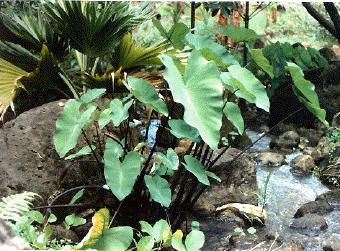 The life of Kanaka Maoli,the indigenous Hawai`i people, is linked closely with kalo,the taro plant. Kalo is believed to havethe greatest life force of all foods. According to the Kumulipo, the creationchant, kalo grew from the first-born son of Wakea (skyfather) and Papa (earth mother), through Wakea's relationship with his andPapa's daughter, Ho`ohokulani. Haloa-naka, as the son was named, was stillbornand buried. Out of his body grew the kalo plant, also calledHaloa, which means everlasting breath. Kalo and poi(pounded kalo) are a means of survival for the Hawai`ipeople. By eating kalo as poi, one ata time as a ritual around the poi bowl (`umeke) at thecenter of the diners, the protocol of Hawai`i is maintained. This is a ceremonyof life that brings people together and supports a relationship of `ohana(family) and of appreciation with the `aumakua (ancestors).
 From earlytimes, kalo was the primary food of the Hawai`i people, supplemented byother principal and traditional foods: sweet potato (`uala), Polynesiansettlers in their canoes and has been cultivated as a mainstay from ancienttimes in the tropical and subtropical latitudinal band around the earth.Taro grows in tropical Africa, the West Indies, the Pacific nations andin countries bordering the Indian Ocean in South Asia. In Hawai`i, wherecultivation has been the most intense, in the early days there were morethan 300 varieties of taro. Approximately 87 of these varieties are stillrecognized today, with slight differences in height, stalk color, leaf orflower color, size, and root type. Some of the local varieties are Mo`i,Lehua, Ha`akea and Chinese.
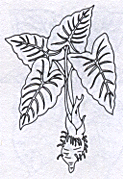
Taro, whose scientific name is Colocasia esculenta (or antiquorum) is cultivated both in the uplandsas high as 4,000 feet, and in marshy land irrigated by streams. The plantis a hearty succulent perennial herb, with clusters of long heart or arrowhead-shapedleaves that point earthward. Taro grows on erect stems that may be green,red (lehua), black or variegated. The new leaf and stem push out of theinnermost stalk, unrolling as they emerge. The stems are usually severalfeet high. Tiny new plants appear around the base of the root corm. Thepua, inflorescence, is an open yellow-white tube, enclosing a spike coveredwith flowers.
Depending on the variety, all parts of this sturdy andvital plant are eaten. The leaves are cooked as greens, similar to spinach.The tubers are eaten baked, boiled or steamed, or cooked and mashed withwater to make poi. The fibrous flesh of the tubers is tough and spongy,ranging in color from white, yellow, lilac-purple and pink to reddish. Mostimportant is the starchy root with enough glutinosity to make quality poi.The stiffest poi is called locally "one finger" and the most liquid"three finger". "Two finger" poi is considered the best.The planters know which kind of taro makes the best poi, which variety hasthe most tender leaves and which has the necessary medicinal properties.
Taro is often fed to babies as their first whole and naturalhealthy food, as well as to the elderly, for its ease of digestion and highvitamin content. Some people call poi the "soul food" of Hawai`i.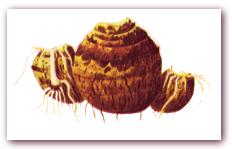 Poi is eaten fresh or allowed to ferment for a few days, often for longer,creating a sour taste considered pleasant, acid, but not alcoholic. In theold days, a person might consume up to five pounds of poi per day. Severalkinds of kalo had such special flavor and color that they were reservedonly for the chiefs. It is said that Soviet astronauts ate dehydrated taroin space, adding water to the packets...instant poi!
In the kalo and poi-based agricultural society, the peopleof ancient Hawai`i were dependent on wetland taro. Great skills were neededto terrace, cultivate and irrigate the land, along with the social and politicalskills to maintain it. The planters of wetland taro were practicing engineers,building walls of earth reinforced with stone to enclose the lo`i (pondfield). Along the banks of the lo`i were planted ko (sugarcane), wauke (papermulberry) for kapa cloth, also known as tapa. In the pond field, severalvarieties of fish were grown, such as `awa, `ama`ama, o`opu and aholehole.An acre of wet lo`i could produce 3 to 5 tons of food per year. Drylandtaro was grown in the lower forests where the soil was rich and the rainfallsufficient.
Today there are still functional lo`i along the Keanae,Wailua and Hana coastlines of Maui, as well as other locations throughout these Hawai`i islands.
A taro farmer exemplifies self-sufficient stewardship ofnatural resources through hard work. There is wisdom in encouraging and supporting community as well as back-yard cultivation of this valuablefood.
In planting both wetland and dryland taro, the huli, theplanting material, consists of a 1/2 inch 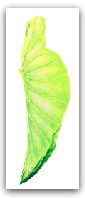 thick slice of the topof the kalo (corm, from which derives the plant's name) attached to 6 to10 inches of the leaf-stem. These protrude above the water or dryland whereplanted. The bottom of the corm/root is saved for cooking and eating, makingtaro a recyclable plant. In 6 to 12 months, depending upon plant varietyalong with soil and water conditions, the taro should be ready to harvest.Each parent tuber produces from two to l5 `oha, side tubers of corms, upto 6 inches in diameter. `Oha means specifically the suckers or shoots concentricallygrowing from the corm of the kalo/taro plant. Knowing this, it is easy tounderstand why the Hawai`i family as a group is termed `ohana, which literallymeans "all from the shoots".
Before kalo can be eaten, all parts of the plant must becooked, in order to break down the needle-like calcium oxalate crystalspresent in the leaves, stem and corm. These could be extremely irritatingto the throat and mouth lining, causing a burning and stinging sensation.
Lu`au is the name of the edible taro leaf, from the wordlau, leaf. Lu`au supplies high amounts of vitamins A, B and C, as well ascalcium, iron, phosphorus, thiamine and riboflavin. The cooked corm andpoi have fewer vitamins, but are an excellent carbohydrate source and havethe ability to balance the pH factor in the body, as they are an alkaliproducing food.
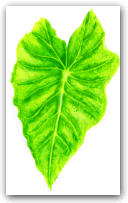 The following are a few of the medicinal usesof poi and the kalo plant. Poi is used to settle the stomach. Mixed withripe pia (arrowroot starch) and taken for diarrhea. Undiluted poi is sometimesused as a poultice on infected sores. A piece of taro stem, haha, can betouched to the skin to stop surface bleeding. Some infections respond tothe use of taro leaves mashed with Hawai`i salt. This poultice can be appliedto an injury, covered and wrapped with a large taro leaf. For a sting froman insect, the stem can be cut and rubbed on the afflicted area.
Mud from the taro patch was used as a black dye for kapacloth.
The kalo plant is said to be the hiapo, the number onesibling. It is also said to be the kinolau, the body form, of Kane, theprocreator. The small round depression where the taro stalk meets the leafsurface is called the piko, from whence comes the name for the human bellybutton.
If we want to learn more about kalo and how to grow it,it is a good idea to talk to the farmers who already grow it. Many of theseare eager to share their knowledge and expertise and many fascinating storiesabout this plant so central to the life of Hawai`i and her people. Exchangingstories and taro varieties with friends and neighbors is the Hawai`i way.
As kumu Kawaikapuokalani Hewitt said "Our existencedepends on Haloa, our elder brother, the Kalo."
 | May the mother nation Hawai`i live forever through the poi! |
 From "The 24 Canoe Plants of Ancient Hawai`i" © Lynton Dove White, Hana, Maui |
| More Canoe Plants `Ape - `Awa- `Awapuhi - Hau - Milo - Niu- Noni - `Ohe - `Ohi`a `Ai - `Olena - Olona - Pia - `Uala- Uhi - `Ulu - Wauke |

Return to the
Taro Festival Homepage
E-mail: info@tarofestival.org
http://www.tarofestival.org/kalo.html